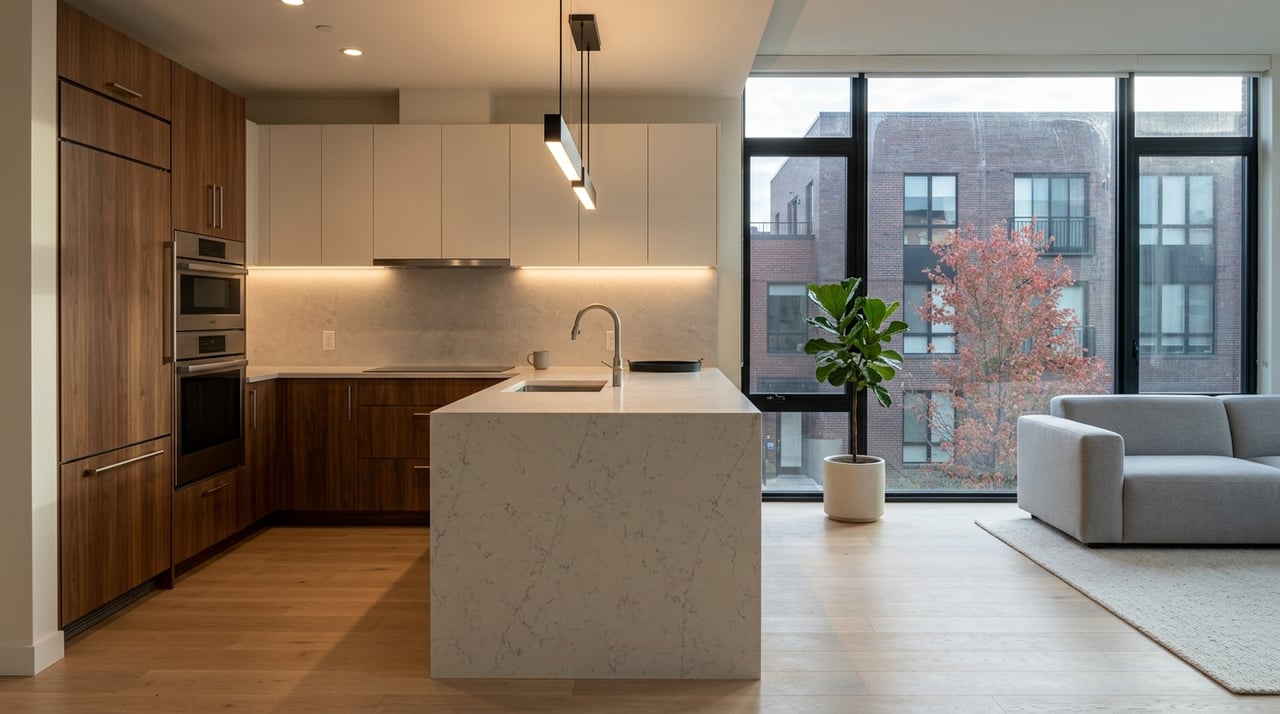
Picture two condos in the same Cambridge building, each assessed at $800,900. One owner lives in the unit and the other rents it out. Under the FY27 figures the City Council approved on September 28, 2026, the owner-occupied unit's tax bill comes to about $1,950 a year. By our own math at the same rate, the rental unit's bill comes to about $5,566. Both units are the same size, in the same building, at the same assessed value, and one pays close to three times as much.
The cause is Cambridge's 30% residential exemption. Most buyers have heard of it. Fewer understand how it moves money around, and fewer still know about the date that decides whether a new buyer gets it at all.
The exemption is a flat dollar amount, not a percentage off your bill
People often describe the exemption as "30% off," and that's misleading. The City Manager's FY27 tax rate letter explains that it "deducts 30% of the average residential parcel value from each qualifying owner-occupied property before the tax rate is applied." The 30% is calculated once, against the citywide average. What comes out is a single dollar figure, and every qualifying home deducts that same amount.
For FY27, the figure is $520,253 of assessed value. At the proposed residential rate of $6.95 per $1,000, that works out to $3,616 in tax savings. A $700,000 condo and a $4 million house knock the same $520,253 off their assessments. The letter spells out what follows: "The exemption lowers the effective rate most for lower-valued homes because every qualifying property receives the same deduction."
The next sentence in the letter explains who pays for it: "The residential rate rises enough to fund the exemption." Cambridge doesn't give up that revenue. It raises the residential rate, and that higher rate falls hardest on homes that don't qualify, mainly investor-owned units and second homes. It also falls on high-value owner-occupied homes, where the flat deduction covers a smaller share of the assessment.
What that does to the city's median bills
The City publishes median values and tax bills for each residential property class, and its figures already include the exemption. The two columns on the right are our own illustrations. They apply the proposed $6.95 rate to the full median value, as if the property did not qualify.
Property class | FY27 median value | FY27 median bill, owner-occupied | Illustrative bill without exemption | Effective rate, owner-occupied |
|---|---|---|---|---|
Condominium | $800,900 | $1,950 | about $5,566 | about $2.43 per $1,000 |
Single family | $1,917,600 | $9,712 | about $13,327 | about $5.06 per $1,000 |
Two family | $1,735,400 | $8,445 | n/a | about $4.87 per $1,000 |
Three family | $1,982,200 | $10,161 | n/a | about $5.13 per $1,000 |
The two- and three-family rows leave out an illustrative figure on purpose. The City materials we reviewed don't say whether an owner who lives in one unit of a multi-family house gets the deduction against the whole parcel or only against their own unit. Anyone buying a two- or three-family to live in should ask the Assessing Department directly how the deduction would apply.
For the median owner-occupied condo, the exemption covers almost two-thirds of the assessed value, so the effective tax rate drops below half of what the median single-family owner pays. The same exemption covers only about a quarter of the median single-family assessment.
FY27 widened the gap
Compare FY26 with FY27. The residential rate went up from $6.67 to a proposed $6.95. The total levy rose 6.9% to $725,384,189. Yet the median owner-occupied condo bill rose only $24, from $1,926 to $1,950. The median single-family bill rose $836, the two-family bill $851, and the three-family bill $766.
Two things kept the condo increase small. Condo values were flat in the FY27 assessment, which is based on 2025 market activity. The exemption also grew, from $510,208 to $520,253 of assessed value, and its tax savings rose from $3,403 to $3,616. Because the deduction got larger as the rate went up, owners of lower-value homes were mostly shielded. An investor holding a median-value condo gets no such shield. By our math, that bill rose from about $5,342 at the FY26 rate to about $5,566 at the FY27 rate.
For someone comparing a condo they plan to live in with one they plan to rent out, or a condo with a single-family house, the tax line reflects how the property is used as well as what it's worth. Listings show a seller's past tax bill. That bill reflects whether the seller qualified, which may have nothing to do with what the next owner will pay.
Why falling lab values reach residential bills
The bigger forces in the FY27 numbers come from Kendall Square and the office market. Cambridge's total taxable value fell 3.8% to $70.36 billion. Residential value rose 2.3%, while commercial value fell 12.4%. The City cited "the continued softening of the office and lab markets," along with "high vacancies, excess lab supply, and hybrid work."
Massachusetts lets a city shift part of its levy from residential to commercial property, up to a limit. Cambridge already sets the residential share at the lowest level allowed, a residential factor that gives homes 33.801% of the levy and commercial property 66.199%. The result is the proposed FY27 rates of $6.95 residential and $16.99 commercial. The City Manager's letter describes the risk this way.
"If residential values increase and commercial values continue to decrease, the City could hit the ceiling for the property tax classification shift. Once the classification ceiling is reached, the residential class will bear all tax levy increases while this condition continues."
The pressure is already showing on the commercial side. Last year, Cambridge Day reported that the Council approved a 22% increase in the commercial rate, to $14.07, along with a 5% increase in the residential rate, as lab and office values declined. The Boston Globe covered the same vote and noted that retail, restaurants and hotels could end up carrying larger increases as office and lab values weakened.
If the city ever hits the classification ceiling, more of each year's levy growth would land on the residential rate. Because the exemption is paid for through that rate, the gap between qualifying and non-qualifying owners would probably grow even faster. That's an inference, not a forecast. The City has only said the ceiling is a concern.
The January 1 rule
Eligibility depends on who owns the home and lives in it as a principal residence on January 1. One person can claim the exemption on only one parcel. Because of that date, a buyer who closes this fall misses the current fiscal year's exemption and first becomes eligible the following year.
Here is how the timeline works for someone who closes on a Cambridge home in October 2026 and moves in:
- January 1, 2026 was the ownership and occupancy date for FY27. The buyer didn't own the home then, so they can't claim the FY27 exemption.
- April 1, 2027 is the deadline to apply for the FY27 exemption. It covers owners who already qualified on January 1, 2026.
- January 1, 2027 is the next snapshot date. Following the same pattern the City uses for FY27, a buyer who owns and lives in the home on that date would be looking at eligibility for the next fiscal year, FY28. The City hasn't posted FY28 dates yet.
- After that, the City's FY26 update says owners don't need to reapply every year.
Cambridge also states that a buyer can't rely on an exemption that appears on the seller's bill. The buyer has to qualify on their own. A carrying-cost estimate built from the seller's last bill can therefore make a buyer's first year look cheaper than it will be. On a median-value condo, the difference is several thousand dollars.
New construction adds another wrinkle. The City warns that the tax bill for a newly purchased condo may cover the whole property. Each unit owner's share is based on the common-interest percentage in the deed, and owners can request an apportionment letter from the assessors.
What isn't settled yet
The FY27 figures in this post are the ones the Council approved. They are still subject to approval by the Massachusetts Department of Revenue, and as of October 12, 2026 we found no confirmation that the state has certified them. The City's Finance page still shows FY26 information. FY27 bill dates haven't been posted, and neither has the abatement deadline, which falls 30 days after the actual tax bill is mailed. For reference, the FY26 first-half bill went out November 7, 2025 and was due December 8, 2025.
Quick answers
How many homes get the exemption? About 13,380 owner-occupied homes are on file for FY27, according to the City Manager's letter, and the Assessing Department audits claims. The City's FY26 update put the owner-occupied share at almost two-thirds of residential property.
Is the 30% figure new? No. The Council has approved a 30% residential exemption every year since 2003, and it adopted it again for FY27 on September 28, 2026.
Does the exemption make a pricier home cheaper to own? It lowers every qualifying bill by the same amount, $3,616 at the proposed FY27 rate. Measured as a share of the bill, that's a much bigger cut on a lower-value home than on a high-value one.
If you're deciding between a condo to live in, a unit to rent out, or a single-family house in Cambridge, Sandrine Deschaux + Co can work through the carrying costs with you, including what the January 1 date means for your first year of ownership. Schedule a consultation before you make an offer.
This article is general information, not legal, tax or financial advice. Consult a qualified professional about your situation.